
Harnessing Our Ancestral Intelligence, with Dr. Ruha Benjamin
Memory and imagination allow us to understand our past and build a future as a collective. And some places carry an unstoppable energy that unleashes both our memory and imagination in the people who visit them.
Located in the heart of Harlem, Schomburg Center, now part of the New York Public Library system, is one of such places.
Beneath the center’s lobby floor, Langston Hughes's ashes rest under Houston Conwill's Rivers cosmogram. I found myself here this week to attend a talk hosted by the NYPL featuring Dr. Ruha Benjamin, whose work on accessing our ancestral intelligence to dare to imagine a new kind of world had captured my own imagination this summer.
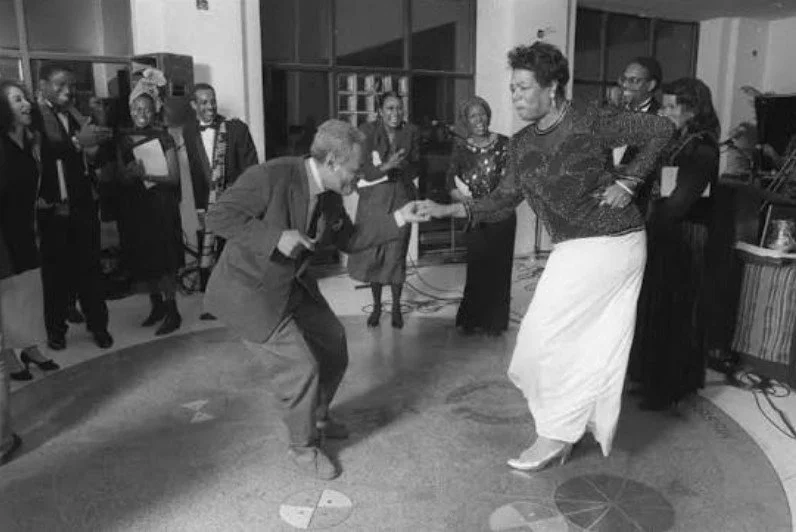
Maya Angelou at the Schomburg Center, dancing with poet Amiri Baraka over Langston Hughes's ashes at the 1991 dedication ceremony of the cosmogram.
Officially, the topic at hand was about AI: power, access, representation. But what panelists Ruha Benjamin and Kamau Bobb worried about wasn't technology so much as the stories embedded in its inputs that shape its direction, and who gets to decide what stories are fed into it.
Neither was asking how we build better machines. They were asking what kinds of people, histories, and imaginations make those machines possible in the first place, and what kind of futures those machines, in turn, will help us build.
"An algorithm is only as good as the story embedded in its inputs."
It was sheer joy bearing witness to these two beautiful and brilliant humans, at the absolute height of their intellectual and oratorical prowess, share their memories and imaginations to stake their claim in the world we’re building, and the stories our descendants will tell their descendants.
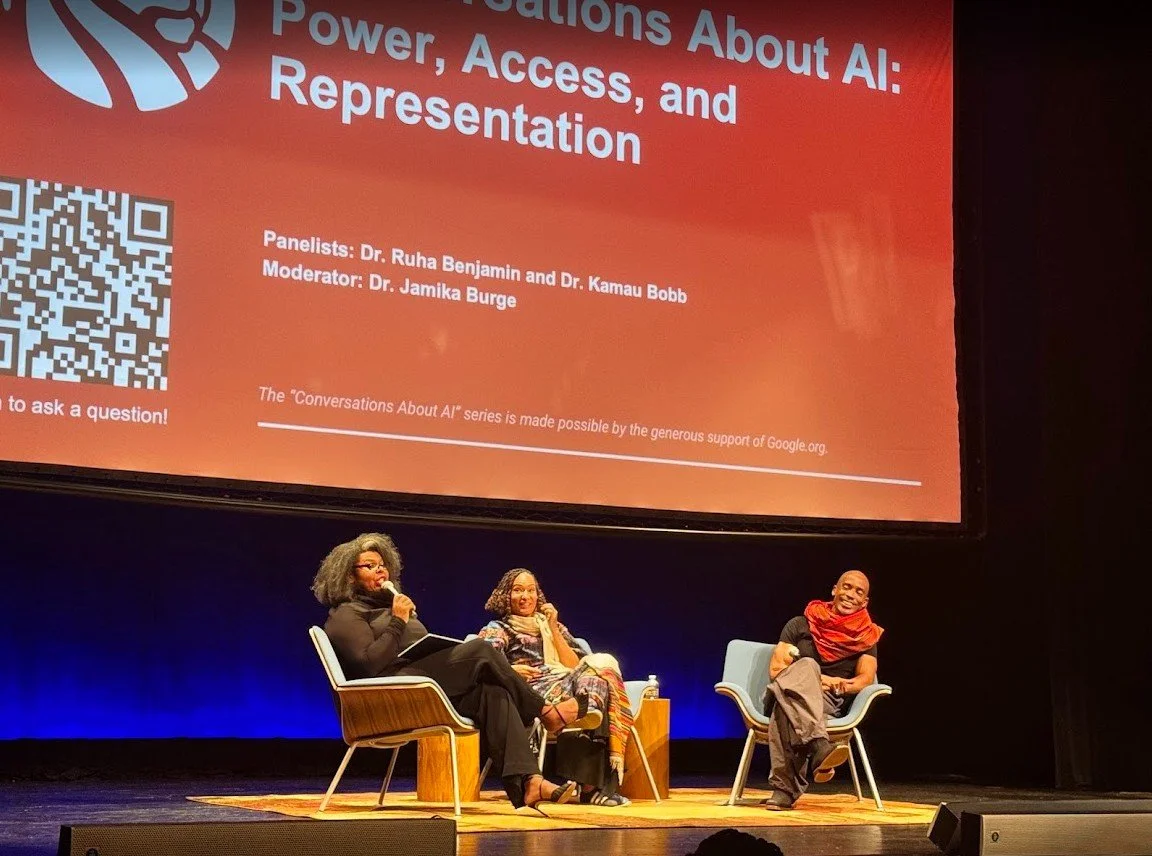
Protectors of our memory and imagination
Dr. Benjamin stoked our collective imagination, calling upon the people in the room inheritors of a fierce intellectual tradition that had to create a new definition of power itself. She urged us to access another kind of AI: Ancestral Intelligence.
She told us that we're trapped between two fantasies. One of techno-dystopia, in which we are the (en)slaved. This is the narrative of Hollywood - the Terminator, the Matrix. The other side of this is techno-utopia, where the benevolent machines will eliminate all hardship and solve all of humanity’s challenges, and we are therefore saved. This is the vision Silicon Valley wants us so badly to buy. But both of these are desires encoded in our digital systems that reflect the desires of a small group of men, and this power is concentrated among so few that it starves the imagination of the actual humanity.
Innovation, captured within these fantasies, only deepens our inequities. A million dreams languish so that a few men can launch a space ship to “colonize” Mars.
Dr. Kamau Bobb, the other panelist, was himself no slouch. He, first and foremost, wanted to imagine a new kind of education. He discussed education not only in terms of helping young people to become better users of AI, but better witnesses. Better historians. Better question-askers (bullshit detectors, to borrow Ruha’s phrase). We desperately need generations of rising young people with more discernment than we, our current generation, have demonstrated. We, the adults in the room, have a responsibilities to guide the next generation, informed by the memories of our Ancestral Intelligence, whose imaginations create a future that does not leave billions in the dark for the benefit of a few with billions of dollars.
This is the true and urgent job of education now. Not simply transferring information, but expanding the range of futures a person believes they can inhabit, and helping them recognize the stories embedded inside every system they encounter. And if the stories they find do not represent their dreams for the future, have the courage and the tools with which to feed it new stories.
This, at its core, is the work of SEUT: cultivating the memory and imagination required to shape a future of ethical technology.