
An Essential List for Emerging Tech Ethicists (in our AI chaos era)
Most reading lists on AI split into two shelves: the optimists' shelf and the doomers' shelf. But as with all technology, this is not a binary fate. I encourage all emerging tech ethicists, regardless of age, to read these five book that have most fundamentally shaped my and SEUT’s mission and philosophy. Read them in this order, and these books will walk you through the diagnosis, the mechanism, the hubris, the tension, and hopefully, an antidote.
Yes, this would be a significant investment of your time. Do you think it will be worthwhile?
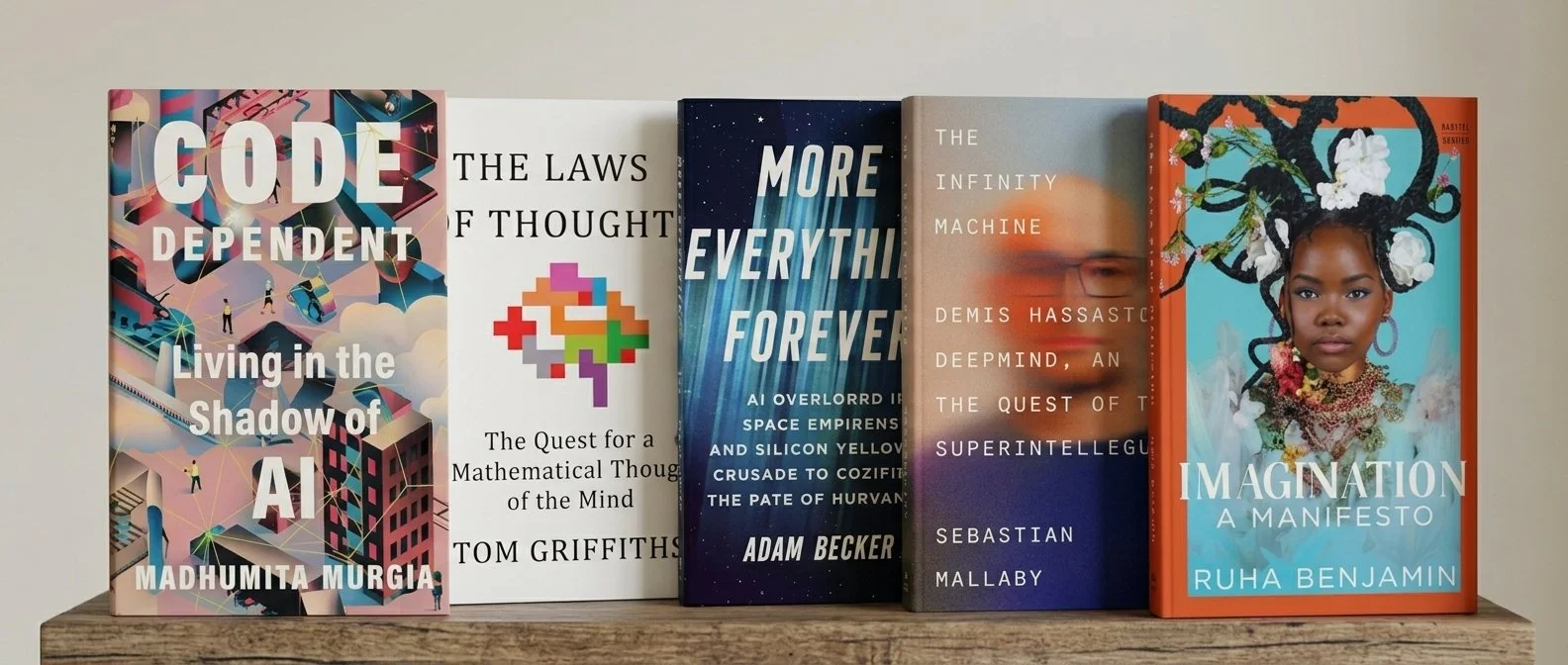
Your essential reading to survive this AI shitstorm era
Start with Code Dependent (2024), by Madhumita Murgia. I’ve devoted a separate post for this one. Murgia, AI editor for the Financial Times, takes you to the other side of the frontier labs of AI that dazzle us and fill the headlines. On the other side are the Kenyan content moderators sifting the worst of the internet for a few dollars a day, the delivery drivers whose entire working life is scored by an algorithm and metrics. You cannot claim to think ethically about a technology you have only ever seen from the user's side of the screen.
Then explore how this technology came to be possible with mathematicians on one side, and linguists on the other, with The Laws of Thought (2026), by Tom Griffiths. Griffiths, a brilliant Aussie academic now at Princeton, takes us through a two-hundred-year journey, from Boole through Turing, Newell, Simon, Chomsky and Hinton (who has an unbelievable connection to Boole!), over whether thought can be deconstructed and documented as rules and systems. This exploration, and their discoveries, is why our current AI technology exists at all. If you can only spare time for just one book out of these five, I’d very reluctantly pick this one, because for a budding ethicist, this book will show you why and how building a model of "how people think" can never be neutral. Reconstructing “laws of thought” can only take place through a set of choices about what counts as reasoning, made by particular people in particular rooms a hundred years ago, and now in a handful of particular people in particular rooms who want glory and profit above all. These choices are deciding what your chatbot thinks a correct answer looks like today. Tell me what’s more important to understand than this for a tech ethicist.
Griffiths shares humanizing stories of these men (and yes, they’re all men), but ready to get really juicy and dark? Turn your attention to, More Everything Forever (2025), by Adam Becker. Becker suffers no fools. While the genius of Tom Griffiths is to make these densely academic and technical concepts approachable without dumbing it down too much, Becker is the one with all the tea and willing to name all the names. He takes the mind-boggling advances in logic, probability theory, and linguistics we just learned about and shows, chillingly, what is happening right now when the complete control of these advances resides in the hands of a very, very small number of men (the Broligarchy, the Nerd Reich…the nicknames keep coming and none is flattering). Story after story, Becker shows us how these men are utterly convinced that their genius entitles them to decide the future for eight billion people.
Now let’s zoom back into the same story, but through the lens of one particular genius who stands just a bit apart from the rest, a truly brilliant work in The Infinity Machine (2026), by Sebastian Mallaby, (this was also required reading for our Founders Cohort students). Hassabis is one of the true pioneers of AI, but won't take the easy win of commercial glory and power (though with the latest demotion of his position and DeepMind, and the effective pausing of AlphaFold, his good fight isn’t looking so good). He is the boy genius from North London who refused to move to Silicon Valley. He’s the scientist at heart who insisted on AlphaFold being open and free for all. He’s the lone person in this bunch with an actual Nobel in Chemistry, with a scientific discovery that actually advances human health using AI. The book doesn’t make a false hero of him, though. He’s not above the machinations of Silicon Valley, and he’s complicit in many ways of the AI arms race being what it is. But it was truly refreshing for me to read this account of the rare person who’s brilliant enough to make whatever he wants out of this technology, yet chooses time and again to take the harder path. Witnessing in real time what this uphill climb costs him, and what it still doesn't fix, is exactly why we all must make this an essential read of our time.
Incidentally, this book also is the best way to understand the latest moves of Mustafa Suleyman (the Microsoft AI Chief), who was a co-founder of DeepMine with Hassabis, and recently in hot water for claiming that most of the white collar tasks would be fully automated within 12-18 months. The book gives a rare peek into Suleyman and his earliest motivations, how he tackles one of the thorniest challenges - healthcare - with AI to help improve outcomes, and how it does not at all work out for him. It’s revealing, it’s discouraging, and yet, the fact that these men are continuing to try give me hope and want to join in in the good fight.
So let’s end with the book that will help you join in the good fight, because we must. It’s easy to lose heart in the chaos of greed and power grab. So please, keep with yourself a copy of Imagination: A Manifesto (2024), by Ruha Benjamin, whose talk I wrote about in my last blog post. This gives you the blueprint for the good fight. Please join in.